The life and times of Sarah our Matriarch. Sarah, the wife of Abraham and, so-to-speak, the co-founder of Judaism, should be, at first glance, the protagonist of this weeks Torah Portion, Parshat Chayei Sarah.
The title of the Parshah includes her name and its literal translation means the “Life of Sarah.” One would be foolish to assume that anyone other than the Mother of our People populated this week’s highlight reel.
When reading the Parsha a classic question arises: Why is the Parshah entitled “The Life of Sarah?” First she died. Then she was buried. Then Abraham sends off his servant to find Rebeccah to be Isaac’s wife and step-in as Matriarch of the Jewish people. Then he marries Keturah, seemingly replacing Sarah. Then Abraham dies, ending their reign. Then Yishmael, who Sarah had removed from her house is discussed.
This seems to be anything but the “Life” of Sarah!
You see, In this Parshah, the Sarah’s message really shines forth. Sarah, in her role in molding the Jewish Nation, saw something Abraham did not: The necessity to close off to the outside world. The need to be insular at times.
Sarah knew that the family that she and Abraham had created would grow to be a major influence in the world, through Isaac, her only son. She prepared Isaac to lead the Jewish people and take them to the next level.
Abraham in his way, always had the door open to the outside. We’ve all heard of Abraham’s famous four-door tent. Sarah on the other hand, saw the importance of protecting Isaac from deleterious influence.
Sarah protected Isaac, whatever it took. When Yishmael proved to be a bad influence, Sarah had him - and even his mother - sent away. Later, even after Sarah died, Abraham sent his six additional sons from his wife, Keturah, away - with all of their off-springs! - as to not allow them to influence Isaac either.
And at the end of the Parsha, we even see that Yishmael, even after being sent away, comes to terms with the fact that it is indeed Isaac, and not him, that will continue the great nation Abraham was meant to be. Yishmael heeds Sarah’s message that Isaac, due to his detachment from detrimental forces, will lead the new Nation.
And when the two ends meet, Yishmael who Sarah sent away, bows in respect to his brother Isaac, whom Sarah protected at all costs, and allows him to peacefully lead the funeral procession for their father, the Life of Sarah truly shines.
_ _ _ _ _
This coming Sunday, Cheshvan 23 (November 20) is the fifth Yahrtzeit (anniversary of passing) of Rabbi Tzvi Hirsh Gansbourg, my maternal grandfather.
My grandfather lived his life in the manner of our Matriarch Sarah, always having his home open to the outside world, but keeping himself and his family protected from outside influence.
The proof of the type of man my grandfather was beams from the homes of his children and grandchildren. Beautiful Jewish homes that not only shine with Yiddishkeit, but that share that warmth and beauty with thousands of Jewish people each year, around the globe.
In this day and age, that's no simple feat! My Zaidy’s efforts have paid off. He has good reason to be looking down from on-high beaming with pride and Yiddishe nachas.
Dear Zaidy, we miss you and love you. Your were a truly special Jew!
Friday, November 18, 2011

Friday, September 23, 2011
On the Move. Shana Tova!
BH
(This Dvar Torah is in memory of Michoel Aron ben Avraham - Michael – Noeth hy”d, who perished in the September 11th, 2001 attack at the Pentagon. Yesterday, Elul 23 on the Jewish calendar, was the corresponding date that year. HY”D.)
This Shabbat, we find ourselves just five short days before the commencement of the New Jewish Year, 5772. We pray that the new year will bring new beginnings and new golden opportunities for each of us.
On Wednesday night of next week we will approach the synagogue with lots on our minds and hearts abotu what we plan for the New Year. We know that G-d is listening.
The second of this weeks Parshiot, Vayeilech, gives meaning and purpose to that transition to a new year.
Vayeilech, which means “he went” (referring to Moses), describes the last days of Moses' life. “Vayeilech” comes from the word 'Halicha' which is also the root for “being on the move.” Not simply “going” somewhere, but a deeper meaning of making a true change to move to another place. A place different hen we currently find ourselves.
With the New Year about to begin we will all experience the idea of “Halicha” independently. But as a nation, we are on the move to greater and brighter horizons.
By taking the time before the New Year to reflect upon the past and make commitments for the future, we are truly preparing for a journey. We are set to be up and on the move. We are in essence being taught to be “movers” and not, heaven forbid, “idlers.” We are tasked with “moving” the world!
To further underatand the idea of “Halicha” another verse in this weeks joint Parsha caught my eye. I mentioned this last year but would like to address it again.
I call this day upon heaven and earth as witnesses. I have set before you life and death, blessing and curse. And you shall choose life, so that you and your children may live. (Deuteronomy 30:19)
These words are written in the first of this weeks two Parshiot (Torah portions). Choose life? Who would choose death anyways? Furthermore, “Choose life so you shall live?” Is that not redundant?
Certainly, as we know the Torah does not have a single letter that is extra, so of course, it is not redundant; but how?
Simple: Lets take a look at the two Parshiot (portions) names’ this week. Nitzavim - standing and Vayeilech - to move. Right now we are standing in one place. In order to move from one place a step needs to be taken. Be it even a tiny step, that's all you need to make the transfer from Nitzavim to Vayeilech!
Choosing life to live is certainly not remaining in one place! Its the act of moving forward. Making a difference. Bettering the world and refining ourselves.
May it be the will of G-d that he grant each of us the greatest of blessing for the upcoming year. May we all only know of happiness and joy in 5772. May the Land of Israel see its oppressors stand down and may the people merit to experience peaceful relations.
May G-d continue to protect our brothers and sisters who stand guard over her. And may G-d continue to give the leaders of the State of Israel the continued wisdom and knowledge to do whats right for Land and the People.
I take this opportunity to wish you a happy and healthy, sweet new year! May you and your loved ones experience much joy, happiness and growth in the year to come!
"K'siva V'chasima Tova, L'shana Tova U'mesuka!"
"May you be inscribed & sealed for a sweet new year!"
(This Dvar Torah is in memory of Michoel Aron ben Avraham - Michael – Noeth hy”d, who perished in the September 11th, 2001 attack at the Pentagon. Yesterday, Elul 23 on the Jewish calendar, was the corresponding date that year. HY”D.)
This Shabbat, we find ourselves just five short days before the commencement of the New Jewish Year, 5772. We pray that the new year will bring new beginnings and new golden opportunities for each of us.
On Wednesday night of next week we will approach the synagogue with lots on our minds and hearts abotu what we plan for the New Year. We know that G-d is listening.
The second of this weeks Parshiot, Vayeilech, gives meaning and purpose to that transition to a new year.
Vayeilech, which means “he went” (referring to Moses), describes the last days of Moses' life. “Vayeilech” comes from the word 'Halicha' which is also the root for “being on the move.” Not simply “going” somewhere, but a deeper meaning of making a true change to move to another place. A place different hen we currently find ourselves.
With the New Year about to begin we will all experience the idea of “Halicha” independently. But as a nation, we are on the move to greater and brighter horizons.
By taking the time before the New Year to reflect upon the past and make commitments for the future, we are truly preparing for a journey. We are set to be up and on the move. We are in essence being taught to be “movers” and not, heaven forbid, “idlers.” We are tasked with “moving” the world!
To further underatand the idea of “Halicha” another verse in this weeks joint Parsha caught my eye. I mentioned this last year but would like to address it again.
I call this day upon heaven and earth as witnesses. I have set before you life and death, blessing and curse. And you shall choose life, so that you and your children may live. (Deuteronomy 30:19)
These words are written in the first of this weeks two Parshiot (Torah portions). Choose life? Who would choose death anyways? Furthermore, “Choose life so you shall live?” Is that not redundant?
Certainly, as we know the Torah does not have a single letter that is extra, so of course, it is not redundant; but how?
Simple: Lets take a look at the two Parshiot (portions) names’ this week. Nitzavim - standing and Vayeilech - to move. Right now we are standing in one place. In order to move from one place a step needs to be taken. Be it even a tiny step, that's all you need to make the transfer from Nitzavim to Vayeilech!
Choosing life to live is certainly not remaining in one place! Its the act of moving forward. Making a difference. Bettering the world and refining ourselves.
May it be the will of G-d that he grant each of us the greatest of blessing for the upcoming year. May we all only know of happiness and joy in 5772. May the Land of Israel see its oppressors stand down and may the people merit to experience peaceful relations.
May G-d continue to protect our brothers and sisters who stand guard over her. And may G-d continue to give the leaders of the State of Israel the continued wisdom and knowledge to do whats right for Land and the People.
I take this opportunity to wish you a happy and healthy, sweet new year! May you and your loved ones experience much joy, happiness and growth in the year to come!
"K'siva V'chasima Tova, L'shana Tova U'mesuka!"
"May you be inscribed & sealed for a sweet new year!"
Saturday, September 10, 2011
An Everlasting Memory.
An Everlasting Memory
By Levi Margolin
September 11, 2009
I grew up in a Chabad House. Chabad of Tidewater to be precise. Throughout the years, hundreds upon hundreds of different people have come and gone. Some we remember quite well. For others, it may take a moment. But only a select few are etched in our everlasting memories.
Michael Allen Noeth was born to a Jewish mother and Roman Catholic father. Sometime after, his mother turned Roman Catholic and his father an observant Jew. Michael was a very gifted artist and joined the navy as a painter. His father requested he visit Chabad wherever his military duties lead him. In 1997, it was Naval Station Norfolk in Norfolk, VA. Michael was added to the catalog of people to stroll through our Chabad House doors. Instantly, he became a fan favorite.

Michael was as kind as they get, and - some would say - as interesting as they get! Michael was a Navy man, there's no mistake about that - he was very proud of who he was. He always tried to rival Tzivos Hashem - the Army of Hashem - with the Navy of Hashem!
We were privileged to share many firsts with Michael. It's hard to forget the faces he made when he unknowingly gulped down Marror as if it were sugar. Michael learned to chant Kiddush with us. I can still hear him yell "Attention Gentlemen" just before the blessing of Hagofen.
Michael quickly became a part of our family. He once attended a family Simcha decorated in his Dress Whites - gloves, hat and all. Almost every Friday afternoon Michael taxied over for Shabbos, with his Stetson perfectly situated upon his head. The conversation with him was always innocent, interesting and heartfelt. He yearned to know more about his faith. As youngsters, we tried our best. We loved Michael. He related to us. He showed us a good time.
After each deployment and trip abroad, Michael always routed his way back to our home. Seeing him never got old - we loved it. In 2000, after a lengthy mission abroad, Michael was officially re-stationed. This time, he was assigned to the Office of the Chief of Naval Operations in the Nation's capital. Oh, Washington, DC. wasn't far. We would see Michael again.
But we didn't. You see, Micheal's new post was in the western side of the Pentagon and on the morning of 9/11/2001, he was proudly positioned there.
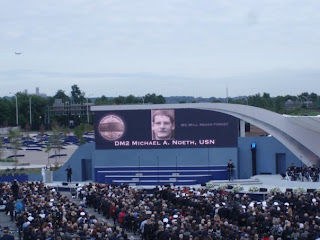
He was gone. Senseless hate and a cowardly act had taken my friend away from me. My family had lost an honorary member. I was only 17 years old, but still I cried. I wept. I mourned.
It's eight years later, and I still tear up when I think of Michael Allen Noeth. A gifted artist. A one-of-a-kind. A Proud Jew, enlisted in the Navy of Hashem.
DM2 Michael Allen - Michoel Aron - Noeth USN, truly etched in my everlasting memory.
By Levi Margolin
September 11, 2009
I grew up in a Chabad House. Chabad of Tidewater to be precise. Throughout the years, hundreds upon hundreds of different people have come and gone. Some we remember quite well. For others, it may take a moment. But only a select few are etched in our everlasting memories.
Michael Allen Noeth was born to a Jewish mother and Roman Catholic father. Sometime after, his mother turned Roman Catholic and his father an observant Jew. Michael was a very gifted artist and joined the navy as a painter. His father requested he visit Chabad wherever his military duties lead him. In 1997, it was Naval Station Norfolk in Norfolk, VA. Michael was added to the catalog of people to stroll through our Chabad House doors. Instantly, he became a fan favorite.

Michael was as kind as they get, and - some would say - as interesting as they get! Michael was a Navy man, there's no mistake about that - he was very proud of who he was. He always tried to rival Tzivos Hashem - the Army of Hashem - with the Navy of Hashem!
We were privileged to share many firsts with Michael. It's hard to forget the faces he made when he unknowingly gulped down Marror as if it were sugar. Michael learned to chant Kiddush with us. I can still hear him yell "Attention Gentlemen" just before the blessing of Hagofen.
Michael quickly became a part of our family. He once attended a family Simcha decorated in his Dress Whites - gloves, hat and all. Almost every Friday afternoon Michael taxied over for Shabbos, with his Stetson perfectly situated upon his head. The conversation with him was always innocent, interesting and heartfelt. He yearned to know more about his faith. As youngsters, we tried our best. We loved Michael. He related to us. He showed us a good time.
After each deployment and trip abroad, Michael always routed his way back to our home. Seeing him never got old - we loved it. In 2000, after a lengthy mission abroad, Michael was officially re-stationed. This time, he was assigned to the Office of the Chief of Naval Operations in the Nation's capital. Oh, Washington, DC. wasn't far. We would see Michael again.
But we didn't. You see, Micheal's new post was in the western side of the Pentagon and on the morning of 9/11/2001, he was proudly positioned there.

He was gone. Senseless hate and a cowardly act had taken my friend away from me. My family had lost an honorary member. I was only 17 years old, but still I cried. I wept. I mourned.
It's eight years later, and I still tear up when I think of Michael Allen Noeth. A gifted artist. A one-of-a-kind. A Proud Jew, enlisted in the Navy of Hashem.
DM2 Michael Allen - Michoel Aron - Noeth USN, truly etched in my everlasting memory.
Friday, September 9, 2011
9.11.2001. Remember.
(This Dvar Torah is in memory of Michoel Aron (Michael Allen) Noeth, USN, who perished in the pentagon on 9.11.2001 and all the innocent lives that were lost on that fateful day. G-d Bless America.)
This Sunday will mark the 10-year anniversary of the atrocities of September 11, 2001. On that day, the world saw evil at its worst. On that same day, the world saw kindness at its best.
Kindness. Unity. Camaraderie. Friendship. Family. Patriotism.
All aspects of good in humanity shined bright as cowards attempted to break our resolve and purpose. Attacking us at our population and business center, the heart of Lower Manhattan, the World Trade Center.
The terrorists aimed to hit us hard and harm our country at the core. They did. But we rebounded. We did not let a group of lowly people determine how we were to live our lives.
Yes, we certainly rebounded and rebuilt. But not without reservation. We all feel it on a daily basis. Less certain. Less safe.
In this weeks Torah portion, Ki Teitzei, we are told, at the very end of the seventh reading, “Remember what the Nation of Amalek did to you... obliterate the remembrance of Amalek from beneath the heavens. You shall not forget!” This lessons is relevant today more than ever.
When Amalek attacked the Jewish Nation on its way out of Egypt, the world saw something which can only be explained as “amazing.” G-d had just finished delivering the Hebrews from the hand of Pharaoh and splitting the Red Sea, amongst a multitude of other miraculous events.
The world saw this clearly! G-d was on the side of the Jewish People and he was going to lead them to the Promised Land! The Egyptians found out the hard way. And as the other Nations of the World saw, miracle after miracle occurred, the ‘mighty’ Egyptians fell and the Jews were well on their way.
Then Amalek came along. G-d? Miracles? Chosen? “Doesn’t bother me!” And they marched forward to attack the Nation of Israel. The world, just as they saw the miracles, saw this as well. And ultimately, even as Irael defeated their unexpected enemy, the Jews were no longer untouchable. Doubt had risen. The Iron Fist which surrounded them seemed weaker.
Nations of the World took note. The Nation of Israel was humbled. And slightly less certain.
Today, we find ourselves in a different world. We know the terrorists wont beat us. We are certain that good will prevail. However, whether we like to admit it or not, we are less certain. Less sure of ourselves.
The modern day “remembering and obliterating” of Amalek begins with each of us. We must obliterate the name of evil. Conquer them and make the world a safe place for our children to live. We must remember the atrocities that occurred, and be certain they don’t happen again.
While the events of 9/11 are certain to never happen, that’s not the only atrocity that needs to be remembered. We must also remember the serenity which existed before and aim for its return to our lives.
May G-d continue to look over our troops who proudly protect the United States of America around the globe. May G-d bestow blessing upon them and their families.
9.11.2001. Remember.
This Sunday will mark the 10-year anniversary of the atrocities of September 11, 2001. On that day, the world saw evil at its worst. On that same day, the world saw kindness at its best.
Kindness. Unity. Camaraderie. Friendship. Family. Patriotism.
All aspects of good in humanity shined bright as cowards attempted to break our resolve and purpose. Attacking us at our population and business center, the heart of Lower Manhattan, the World Trade Center.
The terrorists aimed to hit us hard and harm our country at the core. They did. But we rebounded. We did not let a group of lowly people determine how we were to live our lives.
Yes, we certainly rebounded and rebuilt. But not without reservation. We all feel it on a daily basis. Less certain. Less safe.
In this weeks Torah portion, Ki Teitzei, we are told, at the very end of the seventh reading, “Remember what the Nation of Amalek did to you... obliterate the remembrance of Amalek from beneath the heavens. You shall not forget!” This lessons is relevant today more than ever.
When Amalek attacked the Jewish Nation on its way out of Egypt, the world saw something which can only be explained as “amazing.” G-d had just finished delivering the Hebrews from the hand of Pharaoh and splitting the Red Sea, amongst a multitude of other miraculous events.
The world saw this clearly! G-d was on the side of the Jewish People and he was going to lead them to the Promised Land! The Egyptians found out the hard way. And as the other Nations of the World saw, miracle after miracle occurred, the ‘mighty’ Egyptians fell and the Jews were well on their way.
Then Amalek came along. G-d? Miracles? Chosen? “Doesn’t bother me!” And they marched forward to attack the Nation of Israel. The world, just as they saw the miracles, saw this as well. And ultimately, even as Irael defeated their unexpected enemy, the Jews were no longer untouchable. Doubt had risen. The Iron Fist which surrounded them seemed weaker.
Nations of the World took note. The Nation of Israel was humbled. And slightly less certain.
Today, we find ourselves in a different world. We know the terrorists wont beat us. We are certain that good will prevail. However, whether we like to admit it or not, we are less certain. Less sure of ourselves.
The modern day “remembering and obliterating” of Amalek begins with each of us. We must obliterate the name of evil. Conquer them and make the world a safe place for our children to live. We must remember the atrocities that occurred, and be certain they don’t happen again.
While the events of 9/11 are certain to never happen, that’s not the only atrocity that needs to be remembered. We must also remember the serenity which existed before and aim for its return to our lives.
May G-d continue to look over our troops who proudly protect the United States of America around the globe. May G-d bestow blessing upon them and their families.
9.11.2001. Remember.
Friday, August 19, 2011
Refine Your Act
BH
The following words may surprise no one: I just got back from Israel. Again.
Once again, leading a group of fine young American men and women through the Holy Land at lightning speed. Caesarea, Tiberias, Safed, Galilee, Golan, Jerusalem, the Negev, Tel Aviv and more. 10 short days. Memories that will last a lifetime.
Everyone comes to Israel with their own thoughts. Some verbalize them, others remain silent. One things for sure - with regard to the Land, the State, the People the Religion and the region - each of us has our personal views.
Statements voiced publicly are rooted in the mind and thought. Some things are deliberately kept as thoughts, while others, possibly subconsciously slip through the teeth.
Thoughts are the deepest proof of a person’s inner beliefs and values. Not the speech. However, so often we see people judged based on what they say.
Throughout modern political history or the recent strides of media and news, people find themselves diving head first from top to bottom because of one moment of shame. One thing they said or did in their tenure as a storied reporter or seasoned policy maker.
Its like sixty to zero in 0.8 seconds.
Most recently, stories of Helen Thomas and Anthony Wiener come to mind. But its happened many times. Why such an emphasis on the one act or statement? Cant they be forgiven for the one time mishap? Do they need to have such a tragic downfall for one act or word that literally took 15 seconds?
This weeks Torah portion actually has the answer. Yes. Because the act or opinion is not created on the spot. The tongue doesn't speak its own mind, it speak yours! Its a result of being trained to “keep certain things inside” and suddenly have it squeeze its way through.
Twice in this week’s Torah portion, Eikev, it states “if you shall say in your heart,” i.e., think a thought.
“If you should say in your heart: "These nations are more numerous than I; how can I dispossess them?" (7:17)
“You will say in your heart: "My power and the might of my hand have gotten me this wealth..."
What is the meaning of these two statements? Moses is telling the Jewish people that fearing the enemy in actuality is just as bad as thinking about it. G-d commanded it, then there is no question, not in thought or in action!
Additionally, Moses continues, having thoughts of haughtiness, while not even expressed, is wrongful doing. You shall not even think that your might resulted in anything. Its because of G-d!
Let us all take this opportunity, the second of the seven Shabbats of consolation between the 9th of Av and Rosh Hashana, to think thoughts of consolation rather than destructive harmful thoughts.
Lets polish our ways by refining our minds.
Shabbat Shalom from the Chabad Center at McGill University in Downtown Montreal, Quebec!
The following words may surprise no one: I just got back from Israel. Again.
Once again, leading a group of fine young American men and women through the Holy Land at lightning speed. Caesarea, Tiberias, Safed, Galilee, Golan, Jerusalem, the Negev, Tel Aviv and more. 10 short days. Memories that will last a lifetime.
Everyone comes to Israel with their own thoughts. Some verbalize them, others remain silent. One things for sure - with regard to the Land, the State, the People the Religion and the region - each of us has our personal views.
Statements voiced publicly are rooted in the mind and thought. Some things are deliberately kept as thoughts, while others, possibly subconsciously slip through the teeth.
Thoughts are the deepest proof of a person’s inner beliefs and values. Not the speech. However, so often we see people judged based on what they say.
Throughout modern political history or the recent strides of media and news, people find themselves diving head first from top to bottom because of one moment of shame. One thing they said or did in their tenure as a storied reporter or seasoned policy maker.
Its like sixty to zero in 0.8 seconds.
Most recently, stories of Helen Thomas and Anthony Wiener come to mind. But its happened many times. Why such an emphasis on the one act or statement? Cant they be forgiven for the one time mishap? Do they need to have such a tragic downfall for one act or word that literally took 15 seconds?
This weeks Torah portion actually has the answer. Yes. Because the act or opinion is not created on the spot. The tongue doesn't speak its own mind, it speak yours! Its a result of being trained to “keep certain things inside” and suddenly have it squeeze its way through.
Twice in this week’s Torah portion, Eikev, it states “if you shall say in your heart,” i.e., think a thought.
“If you should say in your heart: "These nations are more numerous than I; how can I dispossess them?" (7:17)
“You will say in your heart: "My power and the might of my hand have gotten me this wealth..."
What is the meaning of these two statements? Moses is telling the Jewish people that fearing the enemy in actuality is just as bad as thinking about it. G-d commanded it, then there is no question, not in thought or in action!
Additionally, Moses continues, having thoughts of haughtiness, while not even expressed, is wrongful doing. You shall not even think that your might resulted in anything. Its because of G-d!
Let us all take this opportunity, the second of the seven Shabbats of consolation between the 9th of Av and Rosh Hashana, to think thoughts of consolation rather than destructive harmful thoughts.
Lets polish our ways by refining our minds.
Shabbat Shalom from the Chabad Center at McGill University in Downtown Montreal, Quebec!
Friday, July 8, 2011
Individuality & Love
BH
This past Tuesday I made a quick trip to NY to visit the graveside of the Lubavitcher Rebbe, Rabbi Menachem M. Schneerson, in commemoration of his 17th yahrtzeit (anniversary of passing).
As Chassidim worldwide gathered at the graveside, I slipped my way into the line, which at 5:30AM was already populated with hundreds people. Each of us were here for the same reason; to pray to G-d surrounded by the holiness of the locale.
While nearly 50,000 passed through “Ohel Chabad Lubavitch” that day, each felt as if he or she were the only one there. Each felt the moment was theirs and theirs alone.
How, amongst tens of thousands, can such individuality could be felt? I turn to the Rebbe himself for an answer.
There is a oft retold story of when the Rebbe used to stand all day - usually for many hours - and distribute dollars to the thousands of people, Jewish and non-Jewish alike, that came to see him. (The dollars were to be given to charity as part of the Rebbe’s Tzedaka campaign.)
A woman, who had never visited before asked the Rebbe how, at his age, he was able to stand there for hours on end and give each person attention as if they were the only one?
“A diamond counter doesn’t tire, even though he may stand all day,” the Rebbe responded with a smile, “each Jew must be treated in that very way!” The Rebbe viewed every person as a gem. As if he or she was the only one!
In keeping with that theme, each person felt the Rebbe personally, as if the Rebbe was his or hers! And the statement is true. The Rebbe was - and continues to be - there for every one of us!
As the Rebbe explained with regard to the righteous and the great Torah scholars: “A true master of life never leaves this world; he transcends it, but he is still within it. He's still there to assist those bonded with him with blessing and advice just as before, and even more so!
“Even those who did not know him in his corporeal lifetime,” the Rebbe continues, “can still create with him an essential bond. The only difference is in us: Now we must work harder to connect.”
In this weeks Parsha, Balak, the prophet Bilaam is summoned to administer curses unto the Jewish people. In a miraculous turn of events, (even after being warned by his talking donkey of the impending ‘blockade’) angels are sent to complicate Bilaam’s path. Eventually, when Bilaam attempts to extend these curses, only blessings come forth.
In one of Bilaam’s unintended praises, he extols the virtues of the “Tents of Israel” that he saw at the camp. That verse from the Torah is one of today’s most often related Jewish phrases: “Ma tovu ohalecha Yaakov, mishkenotecha Yisrael!” (How goodly are your tents, Jacob and your dwelling places, Israel!)
Rashi, the great commentator on the Torah explains that this blessing had several meanings. At face value, Rashi explains, Bilaam was related an observation he had made. At the camp he found himself at, he noticed that the Jewish people had pitched tents in a fashion that no one entrance faced another, giving each ‘home’ their deserved privacy.
Furthermore, we can learn from this verse, and subsequent commentary the importance of individuality. As common as it is today to notice the flashy belongings of an individual, such as his new home, his 100-foot yacht or his $250,000 Bentley, we must learn to keep our eyes and ears in our tents. Focus on what we have!
In the spirit of the Tents of Israel and the Rebbe’s individual love for each person, may we all yearn to aim all focus of ourselves toward being who we can be not who someone else is!
I would venture to guess that we would be a lot more peaceful if were happy with our lot, instead of trying to play “Keeping up with the Goldsteins!”
This past Tuesday I made a quick trip to NY to visit the graveside of the Lubavitcher Rebbe, Rabbi Menachem M. Schneerson, in commemoration of his 17th yahrtzeit (anniversary of passing).
As Chassidim worldwide gathered at the graveside, I slipped my way into the line, which at 5:30AM was already populated with hundreds people. Each of us were here for the same reason; to pray to G-d surrounded by the holiness of the locale.
While nearly 50,000 passed through “Ohel Chabad Lubavitch” that day, each felt as if he or she were the only one there. Each felt the moment was theirs and theirs alone.
How, amongst tens of thousands, can such individuality could be felt? I turn to the Rebbe himself for an answer.
There is a oft retold story of when the Rebbe used to stand all day - usually for many hours - and distribute dollars to the thousands of people, Jewish and non-Jewish alike, that came to see him. (The dollars were to be given to charity as part of the Rebbe’s Tzedaka campaign.)
A woman, who had never visited before asked the Rebbe how, at his age, he was able to stand there for hours on end and give each person attention as if they were the only one?
“A diamond counter doesn’t tire, even though he may stand all day,” the Rebbe responded with a smile, “each Jew must be treated in that very way!” The Rebbe viewed every person as a gem. As if he or she was the only one!
In keeping with that theme, each person felt the Rebbe personally, as if the Rebbe was his or hers! And the statement is true. The Rebbe was - and continues to be - there for every one of us!
As the Rebbe explained with regard to the righteous and the great Torah scholars: “A true master of life never leaves this world; he transcends it, but he is still within it. He's still there to assist those bonded with him with blessing and advice just as before, and even more so!
“Even those who did not know him in his corporeal lifetime,” the Rebbe continues, “can still create with him an essential bond. The only difference is in us: Now we must work harder to connect.”
In this weeks Parsha, Balak, the prophet Bilaam is summoned to administer curses unto the Jewish people. In a miraculous turn of events, (even after being warned by his talking donkey of the impending ‘blockade’) angels are sent to complicate Bilaam’s path. Eventually, when Bilaam attempts to extend these curses, only blessings come forth.
In one of Bilaam’s unintended praises, he extols the virtues of the “Tents of Israel” that he saw at the camp. That verse from the Torah is one of today’s most often related Jewish phrases: “Ma tovu ohalecha Yaakov, mishkenotecha Yisrael!” (How goodly are your tents, Jacob and your dwelling places, Israel!)
Rashi, the great commentator on the Torah explains that this blessing had several meanings. At face value, Rashi explains, Bilaam was related an observation he had made. At the camp he found himself at, he noticed that the Jewish people had pitched tents in a fashion that no one entrance faced another, giving each ‘home’ their deserved privacy.
Furthermore, we can learn from this verse, and subsequent commentary the importance of individuality. As common as it is today to notice the flashy belongings of an individual, such as his new home, his 100-foot yacht or his $250,000 Bentley, we must learn to keep our eyes and ears in our tents. Focus on what we have!
In the spirit of the Tents of Israel and the Rebbe’s individual love for each person, may we all yearn to aim all focus of ourselves toward being who we can be not who someone else is!
I would venture to guess that we would be a lot more peaceful if were happy with our lot, instead of trying to play “Keeping up with the Goldsteins!”
Thursday, June 2, 2011
Conformity, Creativity and Individuality
“And his offering was one silver bowl weighing 130 shekels, one silver sprinkling basin weighing 70 shekels according to the holy shekel, both filled with fine flour mixed with olive oil for a meal offering;
One spoon weighing 10 shekels of gold filled with incense;
One young bull, one ram and one lamb in its first year for a burnt offering;
One young he goat for a sin offering;
And for the peace offering: two oxen, five rams, five he goats, five lambs in their first year.”
This regimen of sacrifices is mentioned in this week’s Parsha, Naso. Its mentioned in the fifth reading, in regards to the offerings brought by Nachshon ben Aminadav on behalf of the Tribe of Yehudah - Judah.
Its also mentioned with regards to the offerings of Netanel ben Tzuar on behalf of the Tribe of Yissachar - Issachar.
Additionally, this prescription is dispatched to Eliav ben Cheylon on behalf of the Tribe of Zevulun - Zebulun - as well.
Elitzur ben Sh’deyur followed the same itinerary on behalf of the Tribe of Reuven - Reuben.
In fact, this schedule of affairs was adhered to by ALL 12 Tribes of Israel (at the time it was the original 12 Tribes, with Yosef - Joseph - replaced by his two sons, Menashe and Efrayim - Manasseh and Ephraim - with Levi not included).
Of course the cliche question at this point is; “Why does the Torah repeat itself 12 times? Does not the Torah prefer to avoid use of extra words?”
Good question indeed! And you are correct, the Torah does not use extra words. None of these repetitions are ‘extra’ or ‘additional’ words. In fact, they are not repetitions at all.
Each recurrence of the designated sacrificial process is unique its own way. While the Torah does not spell it out for us, commentaries have taught that each Tribes’ chieftain offered the gathered components of the sacrifice in his own way.
With each instance, something different was happening. A new idea. A new method. A new format. While it was all prescribed and followed in the same fashion, it was in their hearts and souls that the difference was found.
It is here, that the Torah enlightens us about the holy three-way matrimony between conformity, creativity and individuality.
With each tribal prince bringing the sacrifices with his own heartfelt and soulful method of service to G-d, he is conforming to the directive of the Holy Torah while adding his own individual and personal approach. Its the creativity in each that led to today’s methods of Torah study and commentary.
With today being Rosh Chodesh Sivan, the beginning of the new Jewish Month, the month in which the Holiday of Shavuot* falls, now could not be a better time to focus on this lesson of the Parsha.
We are taught - שבעים פנים לתורה - that Torah has “seventy faces.” The meaning is that of commentary and personal touch. With each individual choosing to learn the Torah and give his or her own personal spark to the holy texts.
May we all learn from the Torah in our own unique way, with the main point focusing on combining the three traits. Conformity, creativity and individuality.
_ _ _ _
May G-d continue to bless the brave men and women of the Israel Defense Force who stand guard over our Holy Land, Eretz Yisrael - the Land of Israel. May G-d bestow blessings and success upon the servants selected to care for the Land.
This Torah thought is brought to you in memory of Mr. Yissachar Dov “Berel” Weiss, OBM, of Los Angeles, CA, patriarch to a family of Chabad-Lubavitch Chassidim and Shluchim - emmisarries - across North America.
Mr. Weiss was a fierce proponent of Torah study and Judaism. Through his immense philanthropy, thousands of Jewish people have been able to learn at Chabad Institutions worldwide. May his memory and inspiration be a blessing to all who knew him.
Shabbat Shalom from the Chabad House at McGill University in Downtown Montreal, Canada where we are wrapping up the celebrations of “graduation week.” Mazal Tov to all the graduates and best of luck in your future endeavors.
*Shavuot begins at sundown on Tuesday, June 7 and lasts through sundown on Thursday, June 9. On Wednesday, June 8, it is customary to hear the 10 Commandments read aloud in the synagogue.
One spoon weighing 10 shekels of gold filled with incense;
One young bull, one ram and one lamb in its first year for a burnt offering;
One young he goat for a sin offering;
And for the peace offering: two oxen, five rams, five he goats, five lambs in their first year.”
This regimen of sacrifices is mentioned in this week’s Parsha, Naso. Its mentioned in the fifth reading, in regards to the offerings brought by Nachshon ben Aminadav on behalf of the Tribe of Yehudah - Judah.
Its also mentioned with regards to the offerings of Netanel ben Tzuar on behalf of the Tribe of Yissachar - Issachar.
Additionally, this prescription is dispatched to Eliav ben Cheylon on behalf of the Tribe of Zevulun - Zebulun - as well.
Elitzur ben Sh’deyur followed the same itinerary on behalf of the Tribe of Reuven - Reuben.
In fact, this schedule of affairs was adhered to by ALL 12 Tribes of Israel (at the time it was the original 12 Tribes, with Yosef - Joseph - replaced by his two sons, Menashe and Efrayim - Manasseh and Ephraim - with Levi not included).
Of course the cliche question at this point is; “Why does the Torah repeat itself 12 times? Does not the Torah prefer to avoid use of extra words?”
Good question indeed! And you are correct, the Torah does not use extra words. None of these repetitions are ‘extra’ or ‘additional’ words. In fact, they are not repetitions at all.
Each recurrence of the designated sacrificial process is unique its own way. While the Torah does not spell it out for us, commentaries have taught that each Tribes’ chieftain offered the gathered components of the sacrifice in his own way.
With each instance, something different was happening. A new idea. A new method. A new format. While it was all prescribed and followed in the same fashion, it was in their hearts and souls that the difference was found.
It is here, that the Torah enlightens us about the holy three-way matrimony between conformity, creativity and individuality.
With each tribal prince bringing the sacrifices with his own heartfelt and soulful method of service to G-d, he is conforming to the directive of the Holy Torah while adding his own individual and personal approach. Its the creativity in each that led to today’s methods of Torah study and commentary.
With today being Rosh Chodesh Sivan, the beginning of the new Jewish Month, the month in which the Holiday of Shavuot* falls, now could not be a better time to focus on this lesson of the Parsha.
We are taught - שבעים פנים לתורה - that Torah has “seventy faces.” The meaning is that of commentary and personal touch. With each individual choosing to learn the Torah and give his or her own personal spark to the holy texts.
May we all learn from the Torah in our own unique way, with the main point focusing on combining the three traits. Conformity, creativity and individuality.
_ _ _ _
May G-d continue to bless the brave men and women of the Israel Defense Force who stand guard over our Holy Land, Eretz Yisrael - the Land of Israel. May G-d bestow blessings and success upon the servants selected to care for the Land.
This Torah thought is brought to you in memory of Mr. Yissachar Dov “Berel” Weiss, OBM, of Los Angeles, CA, patriarch to a family of Chabad-Lubavitch Chassidim and Shluchim - emmisarries - across North America.
Mr. Weiss was a fierce proponent of Torah study and Judaism. Through his immense philanthropy, thousands of Jewish people have been able to learn at Chabad Institutions worldwide. May his memory and inspiration be a blessing to all who knew him.
Shabbat Shalom from the Chabad House at McGill University in Downtown Montreal, Canada where we are wrapping up the celebrations of “graduation week.” Mazal Tov to all the graduates and best of luck in your future endeavors.
*Shavuot begins at sundown on Tuesday, June 7 and lasts through sundown on Thursday, June 9. On Wednesday, June 8, it is customary to hear the 10 Commandments read aloud in the synagogue.
Subscribe to:
Posts (Atom)